

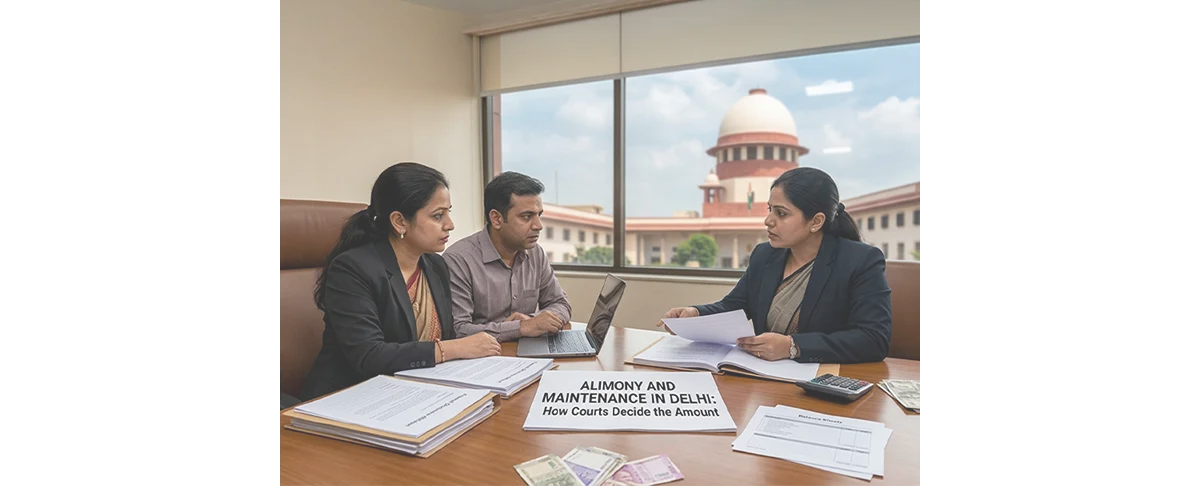
Alimony and Maintenance in Delhi: How Courts Decide the Amount
Let us be honest. When a marriage in Delhi begins to fall apart, the first question that quietly enters most people’s minds is not about court dates or legal procedures. It is a far more immediate one: how will I survive financially after this?
That question is exactly what alimony and maintenance laws are designed to answer. And yet, for something so consequential, this area of law is surrounded by more myths and half-truths than almost any other. Some believe a working wife cannot claim maintenance. Others think there is a fixed percentage formula that courts apply. Many assume only women can seek financial support. None of these is entirely accurate, and walking into a family court in Delhi with the wrong assumptions can cost you dearly.
Whether you are the one who may need to pay or the one who may need to receive, getting clarity from an experienced divorce lawyer in Delhi before proceedings begin is not a luxury. It is a necessity. If you are at that stage right now, AM Legal’s team of the best divorce lawyers in Delhi is available for a confidential consultation. Reach out today.
First, Let Us Clear Up What Alimony and Maintenance Actually Mean
In everyday conversation, people use alimony and maintenance interchangeably, but there is a subtle legal distinction. Maintenance is the financial support one spouse provides to the other, either during the proceedings or after separation. Alimony technically refers to the permanent financial settlement ordered at the time of the final divorce decree. In practice, both terms are used loosely in Indian courts, and the legal provisions cover both.
The right to claim maintenance does not belong exclusively to wives. Either spouse can claim it. However, given the economic structure of most Indian households, where women have often taken career breaks, managed homes, or never entered the workforce, courts find in favour of wives seeking maintenance far more often.
Which Law Applies to Your Case?
The applicable law depends on your religion and the nature of your marriage:
- Hindu Marriage Act, 1955 (Sections 24 and 25): Applicable to Hindus, Sikhs, Jains, and Buddhists. Section 24 covers interim maintenance during the case. Section 25 covers permanent alimony at the time of the final decree.
- Special Marriage Act, 1954 (Sections 36 and 37): For civil or interfaith marriages registered under this act.
- Section 144 of the Bharatiya Nagarik Suraksha Sanhita (BNSS): A secular provision that applies regardless of religion, making maintenance accessible to any spouse in any marriage.
- Muslim Personal Law, Christian Divorce Act, and Parsi Marriage Act: For couples from these communities, the applicable provisions differ, and so does how courts interpret the quantum of maintenance.
If you are unsure which law governs your marriage, speak with a qualified family law advocate before filing anything.
How Do Delhi Courts Actually Decide the Amount?
This is the part people most want to know, and the honest answer is- there is no formula. Courts exercise judicial discretion guided by a set of established factors, which have been refined significantly through Supreme Court and Delhi High Court judgments over the past few years.
The landmark 2021 Supreme Court judgment in Rajnesh v. Neha was a turning point. It made it mandatory for both parties to file detailed affidavits disclosing their income, assets, liabilities, and expenses. No more vague claims of poverty by one and hidden wealth by the other. Delhi courts have since taken income transparency very seriously.
Building on this, the Supreme Court in Parvin Kumar Jain v. Anju Jain (2024) laid down eight specific factors that every court must consider while determining permanent alimony:
- The social and financial status of both parties, including lifestyle indicators such as property owned, vehicles, holidays, and domestic help
- The reasonable needs of the dependent spouse and any dependent children
- The qualifications, employment history, and earning capacity of both parties
- Whether the claimant has any independent income or financial assets
- The standard of living the couple maintained during the marriage
- Career sacrifices or employment breaks taken by the claimant for family responsibilities
- Reasonable litigation costs are borne by the claimant if they are not earning
- The financial capacity of the paying spouse, including their existing obligations, EMIs, and dependents
The court also made clear that alimony should not become a penalty imposed on the paying spouse, nor should it be used to equalise the wealth of both parties. The purpose is to ensure the financially weaker spouse does not fall into hardship after the marriage ends.
What About the Working Wife Question?
This comes up in almost every maintenance case in Delhi today. The husband’s side often argues that since the wife is employed and earning, she has no claim to maintenance. Courts have consistently rejected this oversimplification.
A 2025 Delhi High Court ruling in Vineet Gupta v. Bhawna Gupta made the position clear that even when a wife is employed, she remains entitled to maintenance if her income is insufficient to maintain the standard of living she enjoyed during the marriage. Sustenance in the eyes of the law does not mean bare survival. The court also specifically noted that women who took career breaks to raise children or manage the household face significant disadvantages when re-entering the workforce, including outdated skills, lost professional networks, and employer reluctance to hire after gaps. These real-world consequences are now part of what judges weigh in maintenance decisions.
Homemakers, particularly in long marriages, generally receive greater consideration. Their contribution to the household is recognised as economic in nature, even if unpaid.
Interim vs Permanent: Two Different Stages
Maintenance in Delhi plays out in two distinct phases, and it is important to understand the difference:
Interim Maintenance (Section 24, Hindu Marriage Act)
This is the financial support ordered during the pendency of the case. Its purpose is to ensure the financially dependent spouse does not run out of resources while the litigation is ongoing, which can take months or years. Delhi family courts typically hear and decide Section 24 applications within two to four months. Courts can grant interim maintenance even without a full hearing if there is clear evidence of financial disparity.
Permanent Alimony (Section 25, Hindu Marriage Act)
This is decided at the time of the final divorce decree. It can be awarded as a lump sum or as regular monthly payments. Courts can also modify permanent alimony later if either party can demonstrate a significant change in circumstances, such as the paying spouse losing their job or the receiving spouse remarrying.
What Range Do Delhi Courts Generally Work With?
While no fixed formula exists, legal practice in India has treated the range of one-fifth to one-third of the paying spouse’s net income as a general reference point for lump sum settlements, and up to 25 percent of the paying spouse’s monthly income for recurring maintenance.
In a 2025 Supreme Court ruling, permanent alimony for a divorced wife was enhanced to Rs. 50,000 per month, with a built-in 5 percent revision every two years. The court in that case also directed the transfer of the matrimonial home to the wife’s name. This signals a clear judicial shift toward ensuring the dependent spouse’s long-term financial security, not just a token monthly amount.
In a separate 2025 Supreme Court case involving a one-time settlement, permanent alimony was fixed at Rs. 50 lakh, structured in five installments. Courts are increasingly favouring full and final lump sum settlements in cases where the marriage is clearly over, as it avoids years of future disputes over monthly payments.
What Happens If the Paying Spouse Refuses to Pay?
Non-payment of court-ordered maintenance is not a civil matter that can be quietly ignored. Courts treat it as a serious breach, and the consequences are real:
- Contempt of court proceedings can be initiated, which can result in fines or imprisonment
- The court can attach the defaulter’s bank accounts or salary
- Property can be seized and auctioned to recover arrears
- Employers can be directed to deduct the amount directly from the paying spouse’s salary
Courts in Delhi have become stricter about enforcement over the past few years. Arrears accumulate with interest, and the longer a defaulting spouse delays payment, the more financially damaging the eventual reckoning tends to be.
The Role of Mediation in Alimony Disputes
Delhi family courts actively encourage mediation before and during maintenance proceedings. Many alimony disputes are resolved through mediation, where both parties work with a trained neutral mediator to arrive at a mutually acceptable figure. In mutual consent divorces, couples negotiate alimony as part of the overall settlement package, covering maintenance, child custody, and property division in one structured agreement. Courts then formalise this agreement through the decree. This route saves enormous time and emotional energy. The best divorce law firms in Delhi typically explore mediation early, before positions harden and litigation costs mount.
A Note on Transparency
One of the most important lessons from recent Supreme Court rulings is this: full financial disclosure is no longer optional. Hiding income, undervaluing assets, or suppressing bank statements can now lead to adverse inferences by the court. Judges are required to take a hard look at income affidavits and question figures that do not add up.
If you are the one claiming maintenance, come prepared with documentation of the lifestyle you maintained during the marriage. If you are the one being asked to pay, come with accurate and honest income disclosures.
To Sum It Up
Alimony and maintenance law in Delhi is not about punishing the earning spouse or rewarding the dependent one. It is about fairness, continuity, and ensuring that the end of a marriage does not become the beginning of financial ruin for the partner who gave up more to keep the family together.
Understanding your rights and obligations before entering any negotiation or court hearing is the single most important step you can take. The best divorce advocate in Delhi will not just tell you what the law says. They will map out your specific position, help you prepare the right documentation, and ensure you are not caught off guard at any stage of the proceedings.
AM Legal is a dedicated divorce law firm in Delhi with extensive experience in alimony, maintenance, and matrimonial disputes across Delhi’s family courts. Contact us today for a confidential consultation and let us help you understand exactly where you stand.