


ART & CULTURE | SPECIAL FEATURE
Satyabhama Majhi: Odisha’s Artist Who Turns Soil into Stories and Walls into Memory
From Bhubaneswar’s marketplaces to the Niyamgiri hills and the New Parliament, her art lives beyond the gallery — in community, ecology and everyday life.
Bhubaneswar, Sept 11, 2026: At a time when contemporary art is often associated with gallery spaces, Bhubaneswar-based artist Satyabhama Majhi has spent more than two decades taking art to the people — into market lanes, village walls, hill slopes, public spaces and school classrooms.
A contemporary visual artist, curator, social activist, community art practitioner and Secretary of Sasatwa Foundation, Majhi works across painting, sculpture, installation, photography, mixed media and public art. At the heart of her practice is a focus on connection — between people and place, memory and modernity, tradition and the present.
Early Life: The Market as Her First Studio
Majhi grew up in Bhubaneswar, where she observed everyday life around her father’s small shop in a local market. Vendors bargaining, festivals, neighbourhood relationships, animals and the constant transformation of the city became the everyday theatre that shaped her early artistic perspective.
As Bhubaneswar underwent rapid urbanisation, old neighbourhoods and collective memories began to disappear. Majhi began archiving these changing surroundings through her art.
Her paintings are not portraits of a single individual. Instead, they portray crowded social landscapes featuring people, animals, plants, buildings and rituals, creating a visual record of a changing city.
She holds a Master of Fine Arts (M.F.A.) in Traditional Art, although her practice soon developed into a multidisciplinary artistic language.
The Niyamgiri Dialogue: 12 Years with the Dongaria Kondh
One of the most defining chapters of Majhi’s practice has been her more than decade-long engagement with the Dongaria Kondh community of the Niyamgiri hills.
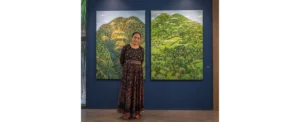
Her work with the community was not simply an exercise in documentation. It involved listening and learning. She studied their livelihood, spirituality, reverence for Niyam Raja and their close relationship with the forest and land.
The experience also influenced the material nature of her art. Inspired by indigenous wall painting, Majhi began creating colours from the land itself, using materials such as chalk stone, charcoal, turmeric, geru soil and brown stone from Niyamgiri, processed with natural binders.
The hill itself became a source of pigment.
Two key concepts emerged from this engagement:
- The Triangle Motif: Drawn from Dongaria visual culture and the silhouette of the Niyamgiri hills, the triangle represents stability, sacred geography and divinity.
- “Up and Down”: Inspired by the daily journeys of Dongria people as they travel up and down the hills for water, markets and rituals, the concept becomes a metaphor for human struggle, movement and resilience.
Two Core Concepts: Un-Urbanisation and Nature as Kin
Majhi’s recent artistic philosophy is shaped by two central ideas.
Un-Urbanisation: She reverses the process of urban development on canvas by bringing trees, animals and village life back into the concrete city. Through this approach, she asks what the city has forgotten.
Dongria Lifestyle with Nature: Her work reflects the idea that for the Dongaria community, nature is not simply a resource to be used but a family to which they belong — representing god, home and identity at the same time.
From Cuttack Walls to the Parliament of India
Public art remains central to Majhi’s belief that art should meet people in public spaces and on the street.
Her large-scale murals and artistic interventions can be seen across Odisha, including Ring Road and Dagabara Sahi in Cuttack. She has also created works for the Men’s FIH Hockey World Cup and Asian Athletics Championships in Bhubaneswar.
Her community projects, including Pago_ and _Thought Loom, transformed walls into spaces for dialogue.
In 2023, she served as Co-Sutradhar and creative contributor to People’s Wall – Jan, Janani and Janmabhumi, a landmark participatory art project commissioned by Lalit Kala Akademi for the New Parliament House in New Delhi. The project brought together women artists and artisans from across India.
The Educator: 15 Years with Children
For around 15 years, Majhi has worked with children, tribal residential schools and children with disabilities through initiatives such as Kalpanadham and in collaboration with Gram Vikas and Tata Trusts.
Her approach to teaching is simple: “Don’t copy, remember.”
Children are encouraged to draw from their own memories — their house, tree, animal, festival or journey through the village. The approach allows their personal experiences and surroundings to become a source of artistic expression.
Recognition and Ongoing Show
Majhi’s works have been presented at Bharat Bhavan Bhopal, Nature Morte Gurgaon, Lalit Kala Akademi New Delhi, Odisha Lalit Kala Akademi, Bhubaneswar Art Trail, Gram Art Project and Vancouver Biennale-linked projects.
She received the Odisha Lalit Kala Akademi State Award in 2012 and the National Lalit Kala Akademi Scholarship for 2009-2010.
Currently, her solo exhibition, Land as Memory, Matter as Landscape, at artCENTRIX Space Gallery brings together different aspects of her artistic journey, where soil becomes memory and landscape becomes story.
At the heart of Satyabhama Majhi’s practice is a question that becomes increasingly relevant in an age of rapid change: How do we keep our places, and our memories of them, alive?

