

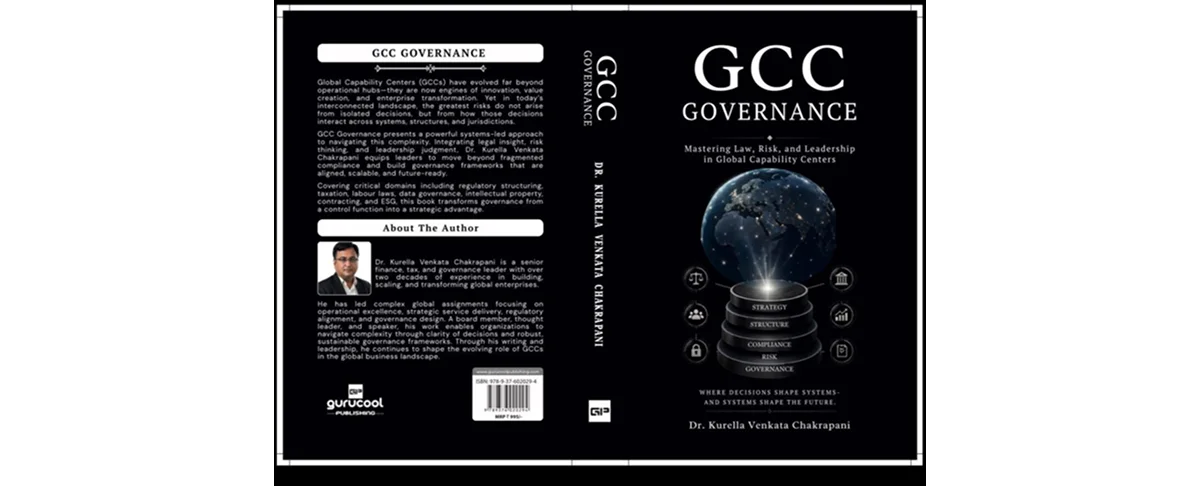
GCC Governance: Mastering Law, Risk, and Leadership in Global Capability Centers
Global Capability Centers (GCCs) have transformed significantly over the past decade. Once viewed primarily as cost-efficient operational hubs, GCCs have now emerged as strategic engines of innovation, digital transformation, business resilience, and global value creation. As their responsibilities expand across countries, functions, and regulatory environments, effective GCC governance has become essential for sustainable growth.
It is in this evolving business landscape that Dr. Kurella Venkata Chakrapani’s book, GCC Governance: Mastering Law, Risk, and Leadership in Global Capability Centers, offers a timely and practical perspective for business leaders, finance professionals, governance experts, and decision-makers managing complex global operations.
The book was launched by Sri D. Sridhar Babu, IT s Legislative Affairs Minister, Government of Telangana, marking an important moment for a publication focused on the governance challenges and opportunities shaping India’s rapidly expanding GCC ecosystem.
Understanding the Complexity of GCC Governance
Modern GCCs operate across multiple jurisdictions, regulatory frameworks, business functions, and stakeholder groups. Decisions related to taxation, labour laws, contracts, data, intellectual property, compliance, and environmental, social, and governance (ESG) responsibilities can no longer be treated as isolated issues.
The book presents GCC governance as a systems-led discipline, where individual decisions can influence broader organizational structures, risks, and business outcomes. Instead of viewing governance merely as a compliance requirement, Dr. Chakrapani encourages leaders to consider it a strategic capability that supports agility, accountability, resilience, and long-term enterprise growth.

Moving Beyond Traditional Compliance
One of the central themes of GCC Governance is the need to move beyond fragmented compliance models. As organizations scale their global capability centers, traditional approaches that focus only on individual regulations may not be sufficient.
The book brings together legal understanding, financial insight, risk management, and leadership judgment to help organizations develop governance frameworks that are aligned, scalable, and future ready.
By connecting law, risk, finance, leadership, and governance, the book provides a broader perspective on how GCC leaders can make informed decisions in an increasingly interconnected global business environment.
Key Areas Covered in the Book
GCC Governance explores several critical areas that influence the operation and growth of global capability centers. These include regulatory structuring, taxation, labour laws, data governance, intellectual property, contracting, risk management, and ESG.
Each of these areas can significantly affect a GCC’s operational efficiency and strategic direction. Strong governance can help organizations identify potential risks earlier, improve decision-making processes, strengthen accountability, and create structures capable of adapting to changing regulatory and business conditions.
The book therefore positions governance not simply as a control mechanism, but as a potential strategic advantage for GCCs.
About Dr. Kurella Venkata Chakrapani
Dr. Kurella Venkata Chakrapani is a senior finance, tax, and governance leader with more than two decades of experience in building, scaling, and transforming global enterprises.
Throughout his professional journey, he has worked on complex global assignments involving operational excellence, strategic service delivery, regulatory alignment, and governance design. His experience provides the foundation for the practical perspective presented in GCC Governance.
As a board member, thought leader, and speaker, Dr. Chakrapani focuses on helping organizations navigate complexity through clarity of decisions, disciplined thinking, and sustainable governance frameworks. His work reflects the changing role of GCCs in the global business ecosystem and the growing importance of strategic governance.
A Strategic Guide for the Future of GCCs
As GCCs continue to evolve from support centers into enterprise-wide strategic partners, governance will play an increasingly important role in determining their success.
Organizations need frameworks that can accommodate innovation while maintaining regulatory discipline, risk awareness, transparency, and accountability.
GCC Governance: Mastering Law, Risk, and Leadership in Global Capability Centers addresses this need by offering a systems-oriented perspective on one of the most important challenges facing modern global enterprises.
For GCC leaders, finance and tax professionals, legal experts, board members, risk managers, and business executives, the book provides valuable insights into building governance systems that are not only compliant but also strategic, scalable, resilient, and future-ready.
In an era where decisions shape systems and systems shape the future, effective GCC governance can become one of the strongest foundations for sustainable global growth.
Read More and Get Your Copy
Readers and professionals interested in GCC governance, global capability centers, leadership, risk management, taxation, compliance, and corporate governance can learn more about Dr. Kurella Venkata Chakrapani’s work and the journey behind the book through his LinkedIn post.
Read the LinkedIn announcement:
Dr. Kurella Venkata Chakrapani on LinkedIn
Buy GCC Governance on Amazon:
For business leaders, GCC professionals, legal and compliance experts, finance and tax professionals, board members, consultants, and aspiring GCC leaders, the book offers a valuable resource for understanding the evolving relationship between governance, risk, law, leadership, and enterprise transformation.

