

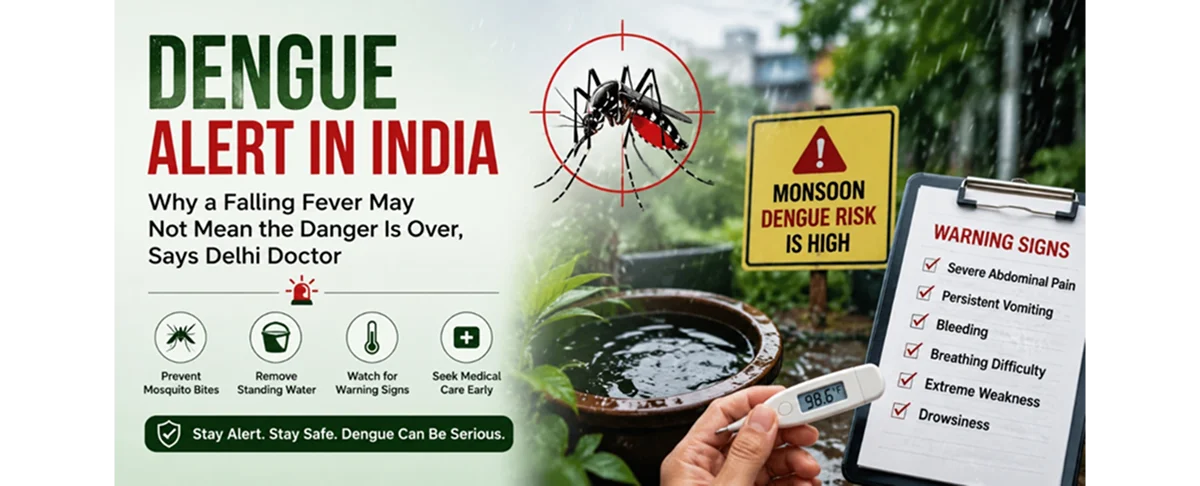
Dengue Alert in India: Why a Falling Fever May Not Mean the Danger Is Over, Says Delhi Doctor
India has recorded 22,938 dengue cases in the first six months of 2026. As the monsoon intensifies, doctors urge people to look beyond fever and platelet counts for signs of severe disease.
As monsoon rains intensify across several parts of India, dengue is once again emerging as a major seasonal health concern. And this year, the warning signs have appeared well before the traditional peak of the dengue season.
According to the European Centre for Disease Prevention and Control (ECDC), India had reported 22,938 dengue cases as of June 2026. The figure highlights the scale of dengue activity even before the peak monsoon and post-monsoon months, when transmission can intensify.
With the peak monsoon and post-monsoon months still ahead, doctors expect dengue surveillance and prevention to remain a priority in the coming weeks.
But for patients, one of the biggest dangers may be misunderstanding what happens after the fever begins to settle.
According to Dr. Tapas Kumar Koley, HOD & Consultant of Internal Medicine at Manipal Hospital, New Delhi, the period when the temperature falls can sometimes be more concerning than the initial fever itself.
“A falling fever does not always mean that the patient is recovering. In some patients, the critical phase of dengue begins around the time the fever subsides,” Dr. Koley said.
Why the fourth or fifth day can matter
Dengue commonly begins with a sudden high fever accompanied by headache, pain behind the eyes, severe muscle or joint pain, nausea, vomiting and sometimes a skin rash. However, these symptoms can overlap with other infections frequently seen during the monsoon, including malaria, chikungunya and other viral illnesses.
The more critical phase of dengue can occur around the third to seventh day of illness, particularly around the time the fever comes down. According to the World Health Organization, some patients can develop plasma leakage, shock, bleeding or organ involvement during this period.
Dr. Koley said this is one of the most important points families should understand.
“Patients and families often feel relieved when the fever comes down. But if the patient develops severe abdominal pain, persistent vomiting, bleeding, breathing difficulty, unusual drowsiness or extreme weakness at this stage, they should seek medical attention immediately,” he said.
These symptoms can indicate warning signs of severe dengue and should not be ignored.
Platelets are not the whole story
Another issue that frequently causes anxiety among dengue patients is the platelet count.
A falling platelet count is common during dengue, but according to Dr. Koley, focusing exclusively on the number can give families a misleading sense of reassurance—or unnecessary panic.
“Dengue severity cannot be assessed by platelet count alone. We look at the complete clinical picture, including blood pressure, hydration, urine output, hematocrit, bleeding and evidence of organ involvement,” he explained.
This means that a patient should not assume that a particular platelet number automatically determines whether hospitalisation or platelet transfusion is necessary.
Medical assessment and monitoring remain more important than reacting to an isolated laboratory value.
The painkiller mistake doctors want patients to avoid
Self-medication is another concern during dengue season.
High fever and severe body aches often prompt patients to take readily available painkillers. However, some commonly used medicines can increase the risk of complications in suspected dengue.
“Aspirin and NSAIDs such as ibuprofen should generally be avoided in suspected dengue because of the potential bleeding risk. Paracetamol is generally preferred for fever and body aches when appropriate,” Dr. Koley said.
Antibiotics should also not be taken routinely for dengue, as the infection is caused by a virus.
Patients should instead follow medical advice regarding hydration, testing and monitoring.
Who should be monitored more closely?
Most patients with dengue recover without developing severe disease. However, some groups may require closer medical observation, including older adults, young children, pregnant women and people with significant underlying illnesses.
The patient’s ability to maintain adequate oral fluid intake and the presence or absence of warning signs are also important factors when deciding whether home monitoring is appropriate.
Prevention remains the first line of defence
Dengue prevention ultimately begins with controlling the mosquito that spreads the infection.
The Aedes mosquito commonly breeds in small collections of stagnant water around homes and neighbourhoods. Water accumulating in coolers, flowerpot trays, buckets, discarded containers, tyres and uncovered tanks can become breeding sites.
Dr. Koley stressed that mosquito control cannot be left entirely to civic authorities.
“Every household should regularly check for stagnant water and eliminate potential mosquito-breeding sites. Personal protection through repellents, appropriate clothing and window screens is also important,” he said.
Unlike the mosquitoes responsible for malaria, Aedes mosquitoes are predominantly active during the daytime, making protection during daylight hours important as well.
The message for this monsoon
With more than 22,938 dengue cases already reported in India during the first six months of 2026, the coming weeks warrant increased awareness rather than panic.
For the public, Dr. Koley believes the most important message is simple: don’t focus on just one symptom or one blood-test value.
“Don’t judge dengue only by the fever, and don’t judge it only by the platelet count. Most importantly, don’t assume that falling fever always means the danger has passed,” he said.
As the monsoon progresses, early medical evaluation, appropriate monitoring and attention to warning signs could make the difference between an uncomplicated illness and a serious complication.
For families dealing with dengue this season, the message is therefore not to fear every fever—but to recognise the signs that demand timely medical care.

